
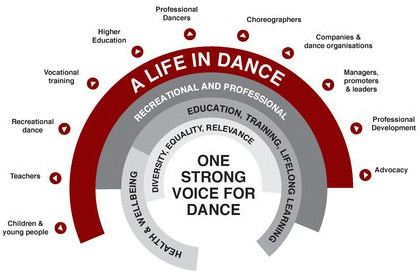
 In March it was announced that Arts Council England has awarded a major grant for a new strategic dance body. The three year commissioned grant for a ground-breaking consortium will bring four leading dance organisations together to create a unified “go-to” industry body: Association of Dance of the African Diaspora (ADAD), Dance UK, National Dance Teachers Association (NDTA) and Youth Dance England (YDE).
This radical transformation is a response to industry demand, affecting both workforce and the support of talent. As a result, the combined impact of these organisations will be much greater than they can achieve as stand-alone bodies. ADAD, Dance UK, NDTA and YDE will pool their expertise to result in a simplified, strengthened and specialist partnership body nurturing and developing talent and delivering excellence in: education; youth dance; dance of the African diaspora; performance, health and well-being; management, leadership and career development. This will become the subject discussion for dance to further the teaching and learning of dance in schools, embedding education at the heart of the dance sector.
The consortium will support a more coherent national approach to the delivery of dance services and will encourage development across the spectrum, from children and young people’s dance, to professional dance practice and being representative of diversity. This new collaborative working model will directly benefit the 40,000 plus dance workforce, and children dancing in and outside school, and indirectly impact on the millions of adults who participate in dance and watch performances. It will provide a single more powerful voice for dance to policy makers and politicians and a centralised knowledge hub, which is ultimately important for the developing arts sector, to promote best practice and nurture talent.
As a result, children and young people’s dance will be central to the work of the new organisation – as well as providing resources for their teachers – bringing together all areas of the dance sector to support young people right from their first steps. The new organisation will create many more exciting and progressive opportunities for young people and dance professionals.
 The music, performing and visual arts sector (including theatre), is now worth £5.4 billion a year in contributing to the UK economy, new figures from the Department for Culture, Media and Sport have revealed. It is clear here that performing arts have a huge value for the UK as a whole, let alone every individual which engages with the arts. The statistics are part of a wider analysis of the creative industries, which now contribute £76.9 billion to the UK economy.
 In December there was the controversial announcement that the Théâtre Royal de la Monnaie, the most important opera house in Belgium and a source of some of Europe’s most cutting-edge productions, may stop all dance programming after a forthcoming production by iconic Belgian choreographer Anne Teresa De Keersmaeker.
 The first National College for the Creative and Cultural Industries is to be established at the High House Production Park in Thurrock, with backing from the government, it has been revealed. The college will open in September 2016 and will provide specialist training for the technical skills needed by the artistic industries.
 Scottish youth arts have benefitted from £1 million from the Scottish government. The Scottish Government has helped secure the future of Scottish Youth Theatre with the announcement of the money, to be used over three years for the youth arts in Scotland. Following so many funding blows for the arts in recent years, the announcement that the Scottish government is to give such a substantial sum is extremely good news.
 Andrew Lloyd Webber’s charitable foundation has announced six grants which will support apprenticeships within professional arts organisations. The grants total more than £150,000, meaning young people will be able to gain better access to the arts, and gain a better chance of success with funds behind them as part of organisations.
 The London Ballet Circle provides financial support to student dancers, raising funds by hosting events such as talks by dancers, choreographers and company directors where members can find out from artists about their life and work. The events of the LBC offer a range of prestigious industry artists as speakers at the events, and the LBC also arranges private visits to ballet schools so members can observe students in training, and their incredible discipline and dedication devoted to their art. All of the LBC events raise vital funds to assist the education of the next generation of talent.
 Students at the prestigious musical theatre college Laine Theatre Arts have had a blow ahead of the new academic year. Epsom and Ewell Council, the area in which the college is situated, has withdrawn housing benefits which many of the student receive.